
Welcome User
Login/Sign Up

Login/Sign Up
₹44
(Inclusive of all Taxes)
₹32 with coupons & bank offers*
Get Free delivery (₹99) with
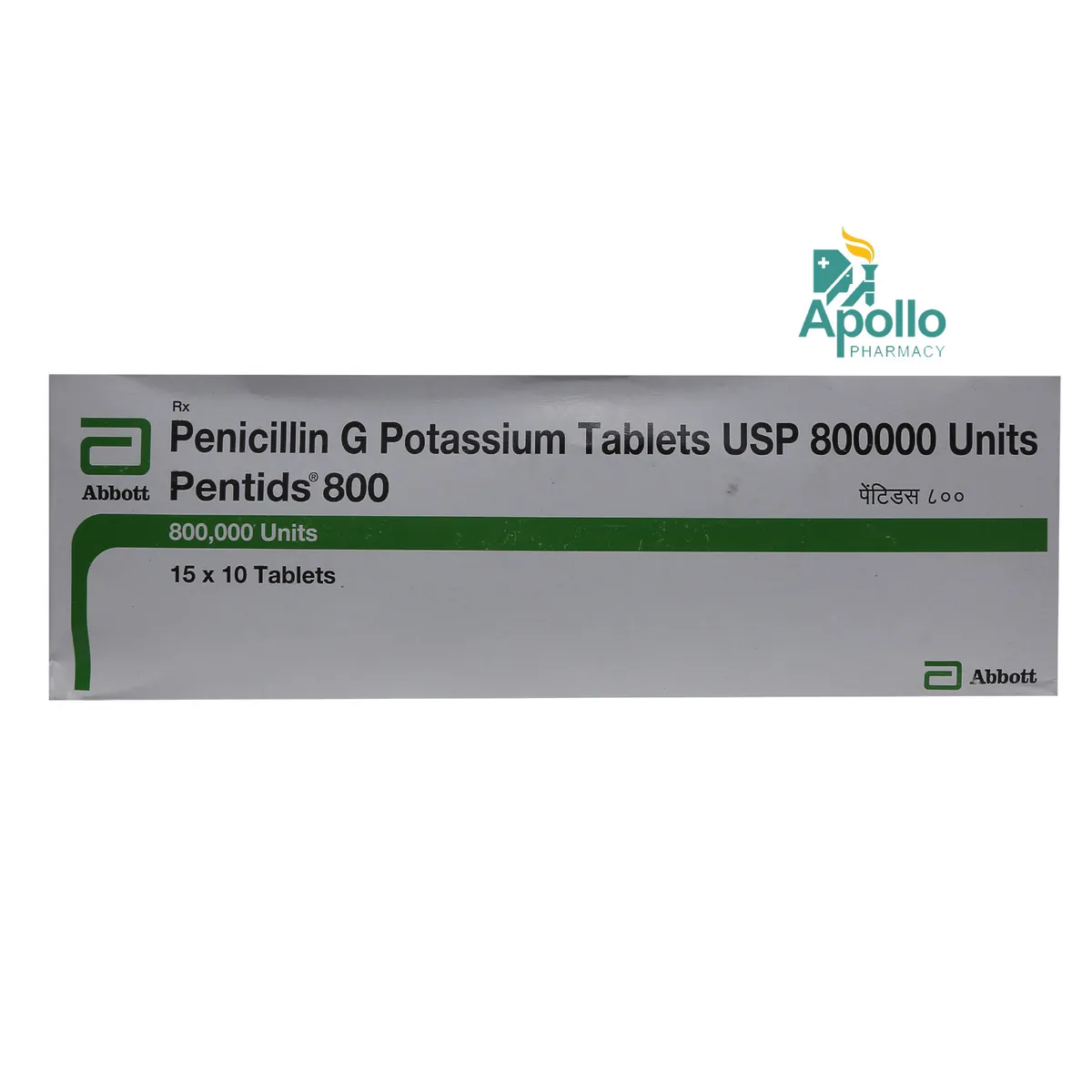
Pentids 800 Tablet belongs to the 'antibiotics' class of drugs, primarily used to treat bacterial infections of the respiratory tract, throat, lungs, nose, and skin. It is useful in treating streptococci and staphylococci infections, diphtheria, meningitis, gonorrhoea, and syphilis. Bacterial infection occurs when harmful bacteria grow in the body and causes illness. It can infect any part of the body and multiply very quickly.
Pentids 800 Tablet contains Penicillin G Potassium, an antibacterial agent. It has bactericidal (ability to kill bacteria) activity against gram-positive and gram-negative aerobic (requires oxygen to survive) and anaerobic (survives with little or no oxygen) bacteria. Pentids 800 Tablet acts by binding to the penicillin-binding proteins (PBPs) inside the bacterial cell wall and inhibits its cell wall synthesis.
Your doctor will advise the dose and duration based on the severity of your infection. Pentids 800 Tablet may cause side effects, although not everybody gets them. Common side effects of Pentids 800 Tablet include stomach pain, headache, nausea, vomiting, diarrhoea, skin rash, yellow-coloured eyes and skin, weakness, and muscle/joint pain. If any of these effects persist or worsen, please seek medical advice promptly.
Brief your medical history to the doctor if you have any allergic reactions to antibiotics. Please inform your doctor if you have any liver/kidney/heart diseases and asthma before using Pentids 800 Tablet . Do not use this medicine while having vaccinations with live bacterial vaccines (typhoid vaccine) since Pentids 800 Tablet may affect the vaccines' activity. Consult your doctor if you are pregnant or breastfeeding before taking Pentids 800 Tablet . Drinking alcohol may lead to unwanted side effects while using Pentids 800 Tablet ; hence please limit or avoid alcohol intake. Pentids 800 Tablet should be used in children only when the doctor has prescribed it.
Pentids 800 Tablet is used in the treatment of bacterial infections. The detailed uses of Pentids 800 Tablet are as follows:
Pentids 800 Tablet contains Penicillin G Potassium, which belongs to the class of antibiotics. It has a bactericidal action against gram-positive and gram-negative aerobic and anaerobic bacteria. It acts by binding to the penicillin-binding proteins (PBPs) inside the bacterial cell wall and inhibits its cell wall synthesis. This process further leads to cell lysis or death. Thus, Pentids 800 Tablet helps treat various bacterial infections.
Caution
Avoid alcohol consumption while taking Pentids 800 Tablet to prevent unpleasant side effects, such as stomach upset, nausea, and vomiting.
Caution
Pentids 800 Tablet should be cautiously used under medical guidance during pregnancy. Please consult your doctor before taking Pentids 800 Tablet if you are pregnant or planning to conceive.
Caution
Penicillin is excreted into the breast milk and may harm a nursing baby. Please consult your doctor before taking Pentids 800 Tablet if you are breastfeeding.
Caution
It is unknown whether Pentids 800 Tablet affects your ability to drive and operate machinery. Drive only if you are physically stable and mentally focused.
Caution
Let your doctor know if you have any history of liver diseases before taking Pentids 800 Tablet . Your doctor will prescribe Pentids 800 Tablet only if the benefits outweigh the risk.
Caution
If you have any history of kidney diseases before taking Pentids 800 Tablet , please inform your doctor. Your doctor will prescribe Pentids 800 Tablet only if the benefits outweigh the risk.
Caution
Pentids 800 Tablet should be given to children only when prescribed by the doctor.
Caution
Pentids 800 Tablet should be taken with caution in patients with heart problems. Please inform your doctor if you have any pre-existing heart problems before using Pentids 800 Tablet .
Caution
Pentids 800 Tablet should be given to elderly patients only if prescribed by a doctor. If you have any concerns about using Pentids 800 Tablet in geriatrics, please consult your doctor.
Include whole-grain foods like multigrain bread and brown rice in your diet.
Taking probiotics after an antibiotic treatment reduces the risk of antibiotic-associated diarrhoea. Try taking yoghurt, cheese, sauerkraut, and kimchi as they help restore the intestine's good bacteria.
Include more fibre-enriched food in your diet that is easily digested by your gut bacteria. Fibre foods may also help restore healthy gut bacteria after a course of antibiotics.
Avoid intake of alcoholic beverages as they can make you dehydrated and affect your sleep.
Manage stress, eat healthily, drink plenty of water, exercise regularly, and get plenty of sleep.
Have a query?
If you have a history of asthma, kidney disease, stomach problems (nausea, vomiting, digestive issues), and heart or liver diseases, please inform your doctor before taking Pentids 800 Tablet . Clostridium difficile-associated diarrhoea (CDAD) is reported during the usage of antibiotics like Pentids 800 Tablet . Therefore, please undergo an examination to rule out the chances of CDAD if you experience diarrhoea following Pentids 800 Tablet therapy. Let your doctor know if you are undergoing any vaccinations with live bacterial vaccines (like typhoid vaccine) since Pentids 800 Tablet may affect vaccines' activity. Please seek medical advice if you are pregnant or breastfeeding before taking Pentids 800 Tablet . Drinking alcohol may lead to unwanted side effects while using Pentids 800 Tablet ; hence please limit or avoid alcohol intake. Pentids 800 Tablet should be used in children only when the doctor has prescribed it.
Drug-Drug Interaction: Pentids 800 Tablet may interact with anticoagulants (warfarin), anti-cancer drugs (methotrexate), pain killers (aspirin, indomethacin), and antibiotics (tetracycline, chloramphenicol).
Drug-Food Interaction: Avoid excess alcohol consumption while taking Pentids 800 Tablet .
Drug-Disease Interaction: Before taking Pentids 800 Tablet , let your doctor know if you have allergic reactions to medicines, kidney disease, asthma, heart or liver diseases, and are undergoing dialysis treatment.
Login/Sign Up
Login/Sign Up
Disclaimer


